
How to Choose an Auto-Steering System: A Buyer's Guide
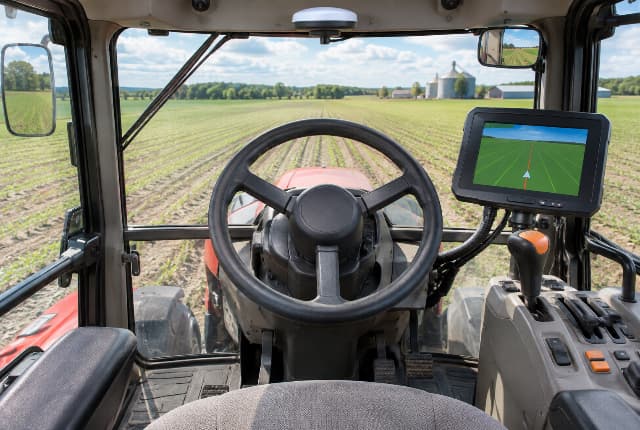
Before you compare accuracy figures or screen sizes, decide which machines the system must steer, which field tasks it must handle, and where its correction signal will come from. A system that does not fit your tractor or cannot receive a usable correction signal in your fields will not deliver its listed accuracy. Shortlist only the suppliers who can confirm in writing that their system is compatible with your machines and correction setup.
Start with your machines and field tasks
List every machine you plan to fit, with brand, model, year and steering type. Then list the operations you want to guide, such as tillage, planting, transplanting, spraying or harvest, and the typical working speed for each.
This list answers most of the later questions. It tells you:
- Which installation kits you need
- What accuracy level your tasks require
- What speed range the system must support
- Whether you need one system you can move between machines or one system per machine
Check compatibility and installation requirements
Industry buying guides list compatibility first among the key considerations. One steering-system article advises buyers to understand what equipment the system needs to operate and how it fits into the vehicle before looking at anything else.
Ask the supplier:
- Which tractor brands, models and steering types the system supports
- Whether your machine needs a vehicle-specific mounting kit
- What installation involves: time, tools, and whether a technician is required
- Whether the system can be moved between machines, and how long that takes
General categories such as "wheeled tractors" or "plant protection machines" are a starting point. They do not confirm that a system fits your particular model.
Understand accuracy specifications and how they are measured
Auto-steering accuracy is quoted in several ways, and suppliers often mix them. Common figures include:
- Positioning accuracy: how closely the GNSS receiver locates the antenna, often written as a fixed value plus a ppm term, for example "0.8 cm + 1 ppm". The ppm term depends on distance, so ask which reference distance applies.
- Orientation (heading) accuracy: usually given as an RMS angle for a stated antenna baseline.
- Steering or line accuracy: how far the machine actually deviates from the guidance line. This is the figure closest to what you see in the field.
A receiver's positioning accuracy does not equal the machine's steering accuracy. For any figure, ask what it measures (pass-to-pass, repeatability or line deviation), which correction mode it assumes, and at what speed it was tested.
Plan for correction signals and connectivity
Centimetre-level figures normally depend on a correction source. Confirm before you buy:
- Which correction source the stated accuracy requires: your own RTK base station, a network RTK/CORS service, or a paid subscription
- Whether that source is included in the price or must be bought separately
- Which GNSS constellations and frequency bands the receiver supports
- Which mobile network bands the modem supports, and whether it works in your country
- What backup exists where mobile coverage is weak, such as a radio link, and what its range and frequency are
- Whether local regulations permit that radio frequency
Check mobile coverage on your own fields. A system marketed for a "global network" may still lack the bands your local carriers use.
Match steering motor and working speed to your operations
Check the steering motor's rated and peak torque, its supply voltage range and its maximum continuous rotation speed. Ask the supplier whether these values suit your steering system, especially on larger or older machines with heavier steering.
Compare the listed working speed range with your slowest and fastest operations. Slow work such as transplanting and faster work such as spraying should both fall inside the supported range. A wide supply voltage range helps on machines with variable electrical systems. Still, confirm that the system works with your machine's electrical supply.
Assess the display, software and controls
Operators use the display all day, so check screen size and resolution for readability in your cab. Ask which software functions are included, for example:
- Straight AB lines and curved lines
- Headland turns
- Implement control or ISOBUS support
- Data export formats
- Interface languages for your operators
Ask for a demonstration, or for screenshots of the actual interface, before committing.
Check durability for field and climate conditions
Ingress protection (IP) ratings show how well each component resists dust and water. The antenna is mounted outside and needs a higher rating than the in-cab display. Compare operating and storage temperature ranges with your local climate, including winter storage in unheated sheds and summer cab temperatures.
Example specification: FMA100GN auto steering system
The manufacturer describes the FMA100GN as combining 4G communication, automatic control, GNSS high-precision positioning, satellite+IMU navigation and an IoT platform. It states that the system covers work from cultivation through planting and management to harvest. It also claims centimetre-level positioning and radio communication that work even where network signals are weak. The manufacturer says the system increases production and efficiency but publishes no figures or field results to support this.
The same product page carries a specification record titled "GNSS". That record does not name a model, so ask the supplier to confirm that these figures apply to the FMA100GN.
| Item | Listed value |
|---|---|
| Applicable to | Wheeled tractors, transplanters, plant protection machines, etc. |
| Communication | 4G global network |
| Positioning accuracy | Horizontal 0.8 cm + 1 ppm; vertical 1.5 cm + 1 ppm |
| Precision discrepancy | < ±25 mm |
| Orientation accuracy (RMS) | 0.2° / 1 m baseline |
| Positioning frequency | 20 Hz |
| Working speed | 0.1–18 km/h |
| Motor peak torque | 16 N·m |
| Motor rated torque | 7 N·m |
| Motor rated voltage | 12 V DC |
| Motor supply voltage | 7–32 V DC |
| Max. continuous rotation speed | 100 r/min |
| Display and control pad | 10.1 inches, 1024×600, 2G RAM + 16G ROM |
| Ingress protection | GNSS antenna IP67; display and control pad IP65 |
| Operating temperature | -30 ℃ to 75 ℃ |
| Storage temperature | -40 ℃ to 85 ℃ |
This record leaves several points open. It does not say which correction source the 0.8 cm figure assumes, or what the "< ±25 mm" precision discrepancy measures. It names no compatible tractor models, supported GNSS bands or radio specifications. The supplier questions below cover these gaps.
Questions to ask your supplier before buying
- Do the published specifications apply to the exact model you are quoting?
- Which of my machines (brand, model, steering type) are compatible, and which kit does each need?
- What does installation involve, and who performs it?
- Which correction source does the stated accuracy require, and is it included?
- What does each accuracy figure measure, and under what correction mode and speed?
- Which GNSS constellations and frequency bands does the receiver support?
- Which 4G bands does the modem support, and does it work in my country?
- What radio is used where mobile signal is weak, what are its range and frequency, and is it legal here?
- Which software functions and languages are included as standard?
- What is the price, and what does the standard package contain?
- What warranty, certifications, after-sales service and spare-parts support do you offer in my country?
- Can you provide documented field results or references from users with similar machines?
Get the answers in writing. They give you a fair basis for comparing quotes and a record to check against the delivered system.